Mail Theft, Change-of-Address Fraud, and Informed Delivery
When mail disappears or an address is changed without permission, secure USPS access, report the postal event, and trace every financial item that may have been diverted.
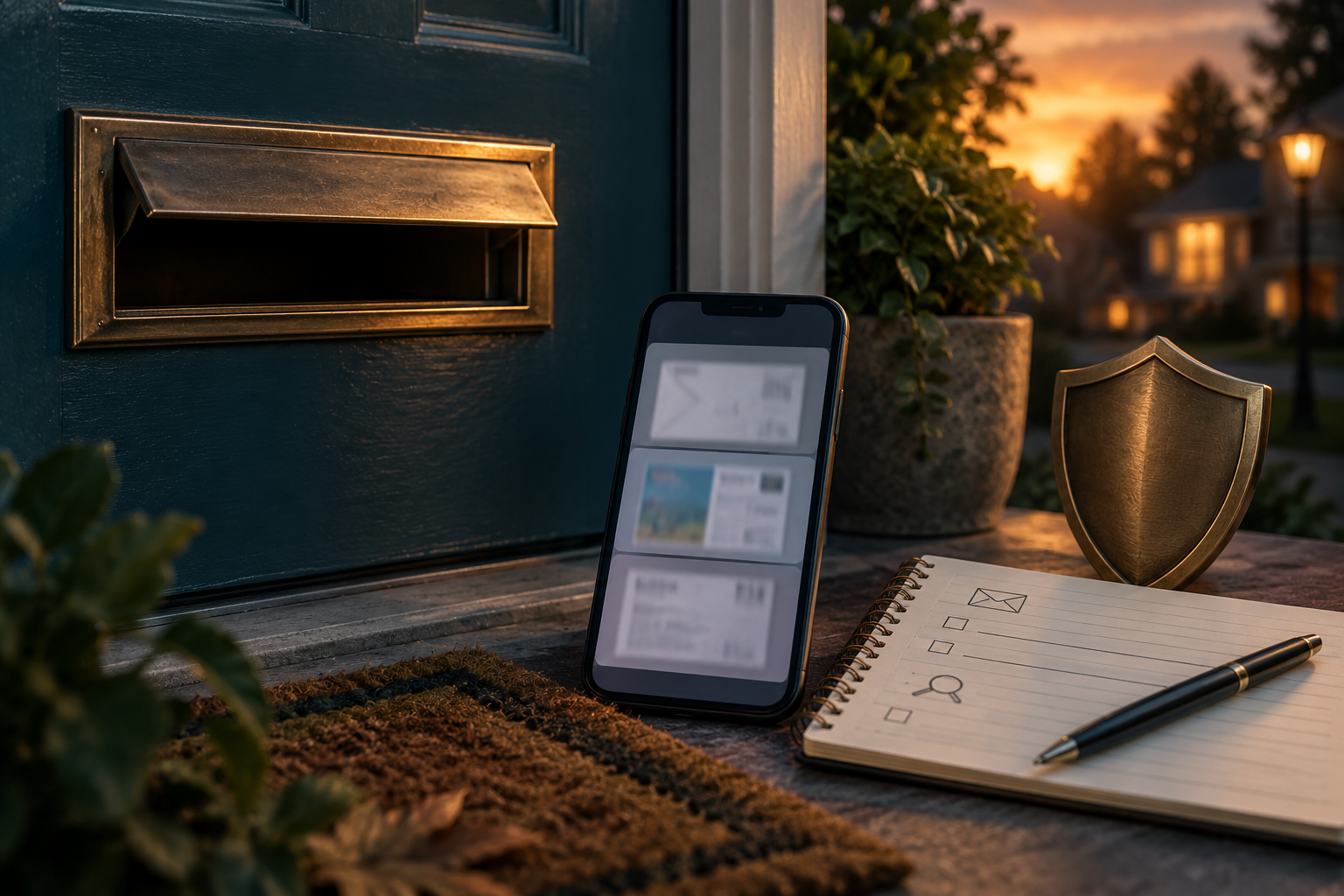
Mail theft can become identity theft when a thief obtains checks, tax forms, replacement cards, government letters, or account-opening mail. A fraudulent USPS change of address or mail hold can also hide the evidence while other fraud continues. If expected mail suddenly stops, review your USPS.com account, check whether a change of address or hold exists, and report suspicious activity through the U.S. Postal Inspection Service. Informed Delivery can provide previews of incoming letter-sized mail and package information, making missing items easier to spot, but it is a visibility tool—not a guarantee that every piece of mail will be imaged or delivered.
Start with the missing object, not the abstract idea of “mail fraud”
Write down exactly what is missing: a replacement debit card, tax document, insurance statement, check, government notice, or ordinary household mail. Ask the sender whether it was issued and to what address. If a financial instrument is missing, contact the bank or issuer immediately. Stop payment on checks when appropriate and replace cards through the fraud channel. The postal investigation and the financial recovery should happen in parallel because a stolen check can be deposited before a mail complaint is resolved.
If the missing item contains an SSN or other identity data, consider credit freezes and monitor the systems relevant to that document. A stolen W-2 creates a different downstream risk than a stolen utility bill.
Check for an unauthorized change of address or mail hold
USPS has added identity-verification controls around changes of address, but fraudulent submissions still deserve immediate attention. Review your USPS.com account and any confirmation letters or emails. USPS guidance notes that a change-of-address submission associated with an Informed Delivery account can trigger a temporary suspension of Informed Delivery for security purposes. If you did not request the change, use the official USPS and Postal Inspection Service channels to report it and restore the correct delivery instructions.
Do not click a “USPS address problem” link in an unsolicited text. Smishing campaigns frequently impersonate delivery services. Navigate to USPS.com yourself and verify the account from there.
Informed Delivery is most useful as an exception detector
Informed Delivery shows grayscale images of the address side of many incoming letter-sized pieces and package information. The value is comparison: if a bank letter appears in the daily digest but never reaches your box, you have a concrete missing item to investigate. It does not image every mailpiece, and a missing image does not prove theft. Use the dashboard and digest as one source alongside sender confirmations and physical delivery.
Protect the USPS.com account itself with a unique password and current recovery information. If someone created an Informed Delivery account for your address without permission, report that specifically; USPIS’s incident form currently includes fraudulent creation of an Informed Delivery account as a reportable event.
A fraudulent address can leak into credit and account records
Review your credit reports for an unfamiliar address that appears alongside a new inquiry or account. Call banks and card issuers to confirm the mailing address on all affected accounts. Check tax and government accounts when sensitive mail was redirected. A stale address by itself is not proof of identity theft, but a new address introduced at the same time as a fraudulent card application is highly relevant evidence.
Keep copies of the postal correction, fraud report, and any sender reissue. If a creditor later asks why you did not respond to a statement or card, the mail-diversion chronology can explain what happened.
| Mail event | Immediate parallel action | Why |
|---|---|---|
| Missing check | Contact the bank or payer, stop payment when appropriate, inspect account activity | The check can be altered or deposited before the mail case is resolved |
| Missing credit/debit card | Call issuer fraud team and replace card | Existing-account fraud is not stopped by a credit freeze |
| Unexpected change of address | Correct USPS record and report the fraud | Diverted mail can hide new-account activity and notices |
| Missing tax form | Ask issuer for a secure replacement and protect tax filing | W-2/1099 data can be used in tax and identity fraud |
| Fraudulent Informed Delivery account | Report to USPIS and recover USPS.com access | Someone may be monitoring incoming mail for valuable items |
Physical mailbox controls still matter
Use a locked mailbox when practical, collect mail promptly, and avoid leaving outgoing checks in an unsecured residential box for long periods. For vacations, use official USPS hold-mail options rather than letting mail accumulate. If a neighborhood experiences repeated theft, report the incidents; patterns can matter to postal inspectors even when one victim’s loss is small.
For high-value or sensitive documents, ask the sender whether secure electronic delivery or in-person pickup is available. Reducing the number of SSNs, checks, and replacement cards in unattended mail reduces opportunity without pretending physical mail can be eliminated entirely.
- □ Confirm the missing item with the sender and save the mailing date and destination address.
- □ Contain the financial or identity risk connected to that specific document immediately.
- □ Review USPS.com, change-of-address status, mail holds, and Informed Delivery access.
- □ Report suspicious postal activity to the Postal Inspection Service using the category that matches the event.
- □ Review credit and financial accounts for a new address or other evidence linked to the diversion.
- □ Preserve the postal report number and correction evidence with the broader identity-theft file.
Finish by reconnecting every diverted document to its owner
After USPS corrects the delivery issue, return to the senders. Confirm replacement cards, checks, tax forms, and government notices reached you securely. Update account mailing addresses directly with each institution rather than assuming the postal correction changed their records. Then continue monitoring the systems exposed by the stolen mail. Postal recovery is complete when mail flow is restored and the high-risk documents that went missing have been individually neutralized or replaced.
Questions specific to Mail Theft, Change-of-Address Fraud, and Informed Delivery
Does Informed Delivery show every piece of mail?
No. It previews many incoming letter-sized pieces and package information, but not every item is imaged. Use it as a comparison tool, not as proof that an unpictured item was never mailed.
What if a change of address was filed without my permission?
Review and correct the USPS record through official USPS channels and report the fraudulent change of address to the U.S. Postal Inspection Service. Also check financial and credit records for addresses or accounts linked to the diversion.
Should I wait for USPS before replacing a stolen bank card?
No. Contact the card issuer or bank immediately. The financial item can be misused while a postal investigation is still pending.
Can someone fraudulently enroll my address in Informed Delivery?
It is a recognized fraud scenario. The Postal Inspection Service reporting workflow includes fraudulent creation of an Informed Delivery account, so report it and secure your USPS.com access.